
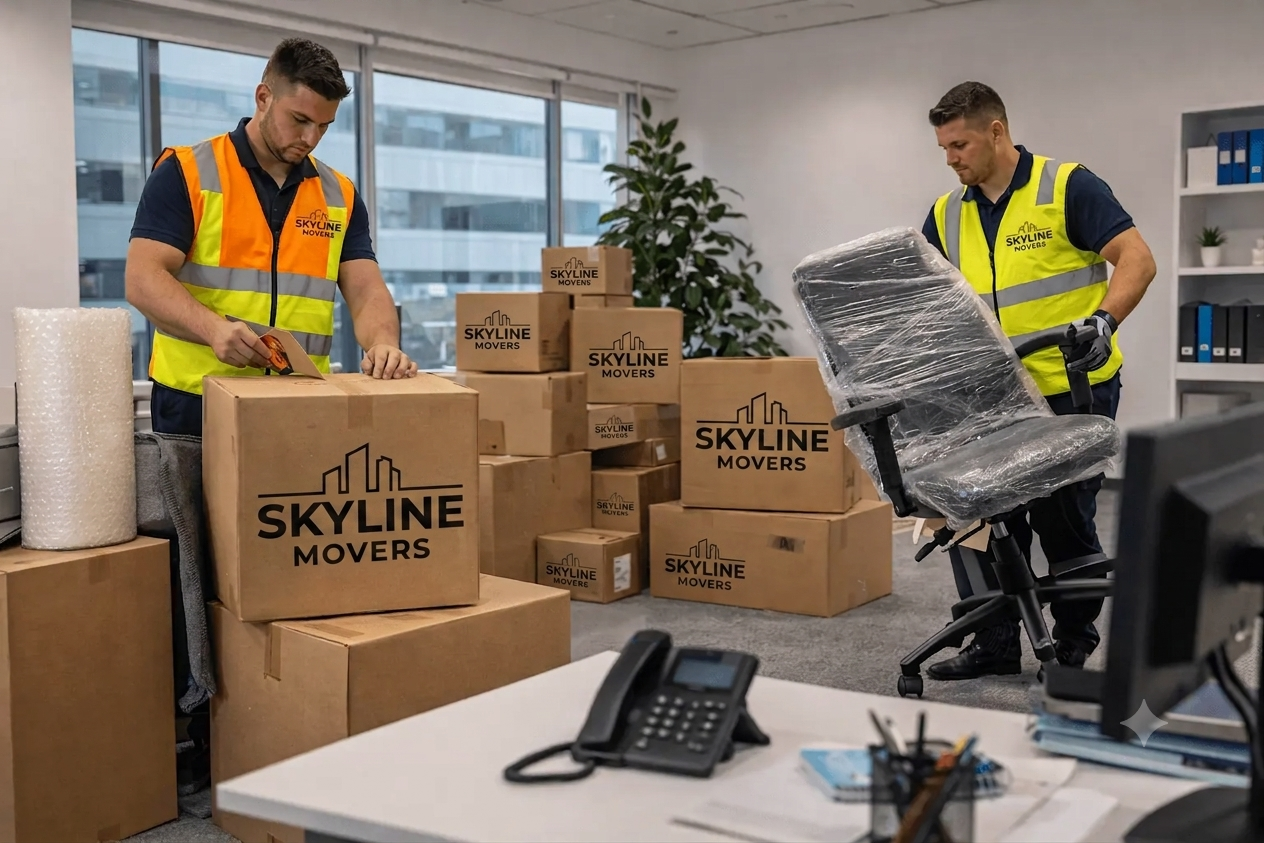
Moving an office is very different from moving a house. An office relocation involves desks, computers, office chairs, filing cabinets, printers, meeting-room furniture, documents, equipment, and many other items that need to be transported safely and efficiently.
More importantly, a business move can directly affect your employees, customers, productivity, and daily operations. Even a small delay can create unnecessary disruption.
That is why choosing the right office removalist in Adelaide is an important part of planning a successful commercial relocation.
At Skyline Movers, we understand that an office move requires careful planning, coordination, and attention to detail. Whether you are relocating a small office, moving an entire corporate workplace, upgrading to a larger premises, or transferring your business to another Adelaide location, professional office removalists can help make the process more organised and efficient.
In this guide, we explain how to plan an office relocation, what to expect from professional office removals, how to protect your equipment, and how to minimise business disruption during your move.
What Is an Office Removalist?
An office removalist is a professional moving service that specialises in relocating businesses and commercial workplaces.
Unlike a standard household move, office removals can involve a combination of:
- Office desks
- Workstations
- Office chairs
- Computers
- Monitors
- Printers
- Photocopiers
- Filing cabinets
- Shelving
- Meeting-room tables
- Reception furniture
- Cabinets
- IT equipment
- Documents
- Office supplies
- Kitchen appliances
- Business equipment
An office removalist can help with the physical process of moving these items from your existing premises to your new location.
Depending on your requirements, office relocation may also involve packing, furniture disassembly, transportation, unloading, and placement of furniture at the new premises.
Why Hire Professional Office Removalists in Adelaide?
Trying to move an entire office without professional assistance can quickly become complicated.
Employees may not have the appropriate equipment or experience to move heavy furniture and delicate technology safely. At the same time, asking staff to spend an entire day moving desks and boxes can take them away from their normal responsibilities.
Professional office removalists can handle much of the physical work, allowing your employees to concentrate on keeping the business running.
1. Minimise Business Downtime
One of the biggest concerns during an office relocation is downtime.
Every hour your team cannot work can potentially affect productivity and customer service.
Professional movers can organise the relocation process around your business requirements. Depending on the circumstances, some businesses may choose to move during:
- Weekends
- After business hours
- Public holidays
- Quieter business periods
Planning the move strategically can help your team return to normal operations as quickly as possible.
2. Safely Move Office Furniture
Office furniture can be large, heavy, and difficult to manoeuvre.
Desks, workstations, conference tables, filing cabinets, and storage units can be particularly challenging in buildings with narrow corridors, staircases, lifts, or restricted access.
Experienced movers understand how to handle bulky furniture and can use suitable moving equipment to reduce the risk of damage.
Furniture may also need to be disassembled before transportation and reassembled at the new office.
3. Protect Computers and Electronics
Modern offices depend heavily on technology.
Computers, monitors, printers, servers, networking equipment, and other electronics can be expensive and sensitive.
These items should be prepared carefully before transportation.
Your office relocation plan should include consideration of:
- Computers
- Monitors
- Printers
- Scanners
- Networking equipment
- Servers
- Phones
- Cables
- Electronic equipment
- Backup devices
IT equipment should be properly disconnected, labelled, packed, and transported.
For critical infrastructure such as servers and specialised networking systems, businesses should also consider involving their IT provider or qualified IT professionals.
Planning an Office Move in Adelaide
Good planning is the foundation of a successful office relocation.
Ideally, you should begin planning your office move several weeks or even months before the moving date, depending on the size and complexity of your business.
A larger office with many employees and extensive equipment may require considerably more preparation than a small workplace.
Step 1: Appoint an Office Relocation Coordinator
Assign one person or a small team to oversee the relocation.
This person can coordinate between:
- Management
- Employees
- Building management
- IT providers
- Office removalists
- Utility providers
- Suppliers
- Customers, where necessary
Having a central point of contact can make communication much easier.
Step 2: Create an Office Moving Checklist
A detailed checklist helps prevent important tasks from being forgotten.
Your checklist might include:
Before the Move
- Confirm the new office
- Confirm the moving date
- Book your office removalist
- Measure important furniture
- Check building access
- Confirm lift availability
- Arrange parking or loading access
- Notify employees
- Plan IT disconnection
- Review office furniture
- Declutter unwanted items
- Organise packing materials
- Label equipment
During the Move
- Supervise loading
- Keep important documents secure
- Check equipment
- Ensure boxes are labelled
- Confirm all areas have been cleared
- Transport items safely
After the Move
- Unload furniture
- Position desks
- Reconnect IT equipment
- Check inventory
- Set up workstations
- Test internet and communications
- Check meeting rooms
- Remove leftover packing materials
Step 3: Declutter Before Moving
An office relocation is an excellent opportunity to get rid of items your business no longer needs.
Over time, offices often accumulate:
- Old paperwork
- Broken furniture
- Outdated equipment
- Unused stationery
- Damaged chairs
- Old promotional materials
- Unused storage items
- Obsolete technology
Moving these items to a new office only creates additional work.
Before moving day, review what you actually need.
Items that are no longer required may be recycled, donated, disposed of responsibly, or handled according to your company’s data and equipment policies.
Step 4: Create an Office Inventory
An inventory can help you keep track of everything being moved.
You could create separate lists for:
Furniture
- Desks
- Chairs
- Cabinets
- Tables
- Shelving
- Reception furniture
Technology
- Computers
- Monitors
- Printers
- Phones
- Networking equipment
Documents
- Filing boxes
- Archives
- Records
Other Items
- Kitchen equipment
- Office supplies
- Promotional materials
- Decorative items
An inventory can make it easier to identify missing or misplaced items after the move.
Office Furniture Removal in Adelaide
Office furniture can account for a significant portion of an office relocation.
Unlike household furniture, office furniture is often modular and may be connected in groups.
For example, workstations may include:
- Desktops
- Dividers
- Cable management systems
- Pedestals
- Drawers
- Screens
Depending on the design, some furniture may need to be disassembled before it can be moved.
Professional office removalists can help manage the physical handling of these items.
Moving Desks and Workstations
Before moving desks and workstations, determine how they will be arranged in the new office.
If possible, create a simple floor plan.
For example:
Workstation Area → 12 desks
Meeting Room → Conference table + 10 chairs
Reception → Reception desk + seating
Manager’s Office → Desk + chair + storage
Providing your movers with a clear layout can help them place furniture in the correct areas instead of moving everything again later.
Moving Filing Cabinets and Office Documents
Documents can be surprisingly heavy.
A box filled with paper can become difficult to lift, particularly when multiple boxes are stacked together.
When packing documents:
- Use appropriately sized boxes
- Avoid overfilling
- Label boxes clearly
- Separate confidential documents
- Maintain any required document-security procedures
- Keep essential records accessible
If your business handles sensitive or confidential information, follow your organisation’s privacy and records-management requirements throughout the relocation.
Office IT Equipment Relocation
Technology is often the most important part of a modern office move.
A successful relocation should include an IT plan.
Before moving day, determine:
- Which equipment is being moved
- Who will disconnect it
- How equipment will be labelled
- Where each item will go
- Who will reconnect it
- When internet services will be active
- Whether servers need special arrangements
- How data backups will be handled
Label Every Computer
A simple labelling system can save considerable time.
For example:
Desk 01 – Marketing
Desk 02 – Accounts
Desk 03 – Sales
Then label the corresponding desk at the new office.
This makes it easier to return each computer and monitor to the correct workstation.
Protecting Your Office Equipment During Transportation
Office equipment should be handled carefully during a relocation.
Items can potentially be damaged through:
- Impact
- Scratching
- Dropping
- Incorrect stacking
- Poor packaging
- Movement inside the vehicle
Professional movers can use suitable protective materials and loading techniques to reduce these risks.
Fragile and high-value equipment should be identified before the move so that appropriate handling arrangements can be made.
Office Removalist Adelaide: Moving Between Buildings
Office relocations can become more complicated when moving between commercial buildings.
Before moving day, check:
- Loading dock availability
- Truck access
- Building opening hours
- Lift access
- Service lifts
- Parking restrictions
- Security requirements
- Access cards
- Building management requirements
- Moving time restrictions
Some commercial buildings have strict rules regarding deliveries and removals.
Contact the building manager at both your old and new locations well in advance.
Moving an Office With Minimal Disruption
Business continuity should be a major priority.
You do not want your entire organisation to stop operating unnecessarily.
One strategy is to divide the relocation into stages.
For example:
Friday Afternoon
Begin packing non-essential items.
Friday Evening
Move furniture and equipment that is not required overnight.
Saturday
Complete the main relocation.
Sunday
Set up workstations and test equipment.
Monday Morning
Employees return to an organised new workplace.
The exact schedule will depend on the size and requirements of your business, but staged planning can help reduce disruption.
Communicating With Employees
Employees should know what is happening before moving day.
Provide clear information about:
- Moving dates
- New office address
- Parking
- Public transport
- Desk arrangements
- Packing requirements
- Working arrangements during the move
- Expected return-to-work date
You may also give each employee responsibility for packing their personal desk belongings while professional movers handle larger furniture and equipment.
Clear communication reduces confusion and helps everyone prepare.
Office Relocation for Small Businesses
Small businesses may assume they can manage an office move themselves.
However, even a small office can contain significant amounts of equipment and furniture.
A small office relocation might involve:
- Several desks
- Office chairs
- Computers
- Filing cabinets
- Shelving
- Printer
- Meeting table
- Kitchen equipment
- Stock or supplies
Professional movers can help small businesses save time and reduce the physical workload involved in relocating.
Large Corporate Office Relocations
Larger office moves require more detailed planning.
A corporate relocation may involve dozens or hundreds of employees and a large quantity of furniture and equipment.
The relocation may need to be coordinated across different departments.
For larger moves, it can be useful to divide the project into stages and assign responsibility for:
- Furniture
- IT
- Documents
- Employee communication
- Building access
- Security
- Scheduling
- Inventory
A detailed relocation plan can help keep the move organised from beginning to end.
Commercial Office Removals Adelaide
Office relocation is not limited to traditional office spaces.
Professional commercial movers may also assist businesses such as:
- Medical offices
- Accounting firms
- Law firms
- Real estate agencies
- Consulting businesses
- Creative agencies
- Startups
- Retail offices
- Training centres
- Professional services businesses
Every workplace has different requirements, so it is important to discuss your specific situation with your removalist before moving day.
How Much Does an Office Removalist in Adelaide Cost?
The cost of an office relocation depends on several factors.
These can include:
- Size of the office
- Number of employees
- Amount of furniture
- Number of computers and equipment
- Distance between locations
- Number of movers required
- Truck requirements
- Building access
- Stairs
- Lift access
- Packing requirements
- Furniture disassembly
- Furniture reassembly
- Time required
A small office with easy access may take considerably less time than a large corporate relocation involving multiple floors.
For this reason, it is best to provide your removalist with accurate information about your office before requesting a quote.
Questions to Ask an Office Removalist
Before booking an office removalist, consider asking:
Are you experienced with commercial office moves?
Experience with office relocations can be valuable because commercial moves have different requirements from household removals.
What is included in the quote?
Ask whether labour, transportation, equipment, furniture disassembly, packing, and other services are included.
Can you move office furniture?
Confirm that the removalist has the appropriate equipment and experience to handle desks, workstations, cabinets, meeting tables, and other commercial furniture.
Can you work outside normal business hours?
If reducing downtime is important, ask whether evening or weekend moving arrangements are available.
What information do you need before moving day?
Providing accurate information about the size of your office and access conditions can help the removalist prepare properly.
Common Office Moving Mistakes
Not Planning Early Enough
Office relocations involve many moving parts.
Waiting until the last minute can result in unnecessary stress and logistical problems.
Start planning early.
Forgetting to Measure Furniture
A large conference table may fit comfortably in your existing office but not through a doorway or lift at the new premises.
Measure important furniture and check access before moving day.
Ignoring Building Restrictions
Commercial buildings often have specific requirements for moving.
Always confirm access arrangements with building management.
Not Backing Up Important Data
Before relocating computers and IT equipment, make sure important business data is appropriately backed up according to your company’s IT policies.
Failing to Label Equipment
Unlabelled computers, monitors, cables, and boxes can create confusion at the new office.
A simple labelling system can make setup much easier.
Moving Without a Floor Plan
Without a layout plan, movers may place furniture wherever there is available space.
Providing a floor plan can help ensure desks and furniture are positioned correctly.
How to Prepare Your Office for Removalists
When the moving team arrives, preparation can make the process much faster.
Before they arrive:
- Clear walkways
- Remove personal belongings from desks
- Pack small loose items
- Label boxes
- Secure important documents
- Disconnect equipment where appropriate
- Confirm building access
- Reserve lifts if required
- Ensure loading areas are accessible
The more organised your office is, the easier it can be for the moving team to work efficiently.
Moving Your Office in Adelaide With Skyline Movers
Choosing the right office removalist in Adelaide can make a major difference to your relocation experience.
At Skyline Movers, we understand that an office move is more than simply transporting furniture from one address to another.
Your business needs to keep disruption to a minimum, your equipment needs to be handled carefully, and your new workplace needs to be ready for your team.
Our approach is focused on making the physical relocation process organised and straightforward.
Whether you are moving a small office, relocating a growing business, or planning a larger commercial move, we can discuss your requirements and help you plan the relocation.
Why Choose Skyline Movers for Office Removals?
When selecting a professional moving company, businesses need reliability, communication, careful handling, and efficient planning.
Skyline Movers can assist with the practical aspects of your office relocation, including the transportation and handling of office furniture and belongings.
We understand that every business is different.
Your office may have:
- Heavy furniture
- Multiple workstations
- Sensitive equipment
- Large quantities of documents
- Difficult access
- Multiple floors
- Tight moving schedules
That is why office relocation should be planned around the specific requirements of your business.
Your Office Move Starts With a Plan
An office relocation does not have to become a major disruption to your business.
The key is to start planning early and work with an experienced office removalist in Adelaide.
Create an inventory, communicate with employees, organise building access, prepare your IT equipment, label your belongings, and establish a clear moving schedule.
With the right preparation and professional moving assistance, you can make the transition to your new office considerably smoother.
Whether you are moving across Adelaide or relocating to a new commercial premises, Skyline Movers can help you take the next step.
Ready to Move Your Office?
Planning an office relocation?
Contact Skyline Movers to discuss your requirements and find out how professional office removal services can help make your Adelaide business move easier.
From office desks and chairs to computers, filing cabinets, meeting-room furniture, and other workplace belongings, careful planning can help ensure your business is ready for its next chapter.
Skyline Movers – Professional Office Removalists in Adelaide.